|
|
Joined: Jul 2003
Posts: 230
Contributor
|
OP

Contributor
Joined: Jul 2003
Posts: 230 |
just got done with August and September is still hot here in Florida,, this engine will not run cool,,,
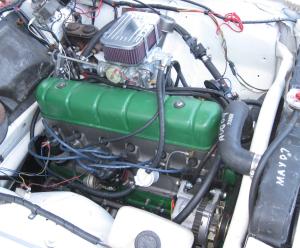
Mild 250 build in a 1965 nova, its got a 4core supercool radiator from US Radiators out of Classic Industries, 5 square bladed steel flex fan, 1 inch from core face and 1/2" from balancer, shroud to the center of the blade arch and both sides of rad to across the top, the bottom cannot be shrouded the fan blades go past the bottom tank, and a high volume water pump, found this listing at autozone for a 1977 250,, just has a impeller cover on the back, no other differences I see, at idle this thing climbs temp till I gamble to shut it down, it burps all over the drive,,,the fan pulls enough air to suck a shop rag to the grill at idle,,,,
???could I be pumping to much water and the area of the rad is just dropping the water back to the engine before it has time to expell the heat from the system,just circulating hot water,,I'm lost, it's been years with this problem,,any ideas,,,
Last edited by fingersix; 09/15/09 02:07 PM.
|
|
|
|
|
Joined: Apr 2004
Posts: 3,595 Likes: 42
1000 Post Club
|
|
1000 Post Club
Joined: Apr 2004
Posts: 3,595 Likes: 42 |
Finger,
here is a few questions.
1. What temp thermostat?
2. What is the timing settings?
3. What carb/intake manifold.
4. Where is the temp guage sender located?
Maybe you are running it lean. Does the engine accelerate cleanly? No bumbling. Is the idle clean also.
Maybe a pic or 2 of the setup. Tom
Inliner Member 1716 65 Chevelle Wagon and 41 Hudson Pickup Information and parts www.12bolt.com
|
|
|
|
|
Joined: Jul 2003
Posts: 230
Contributor
|
|
OP
Contributor
Joined: Jul 2003
Posts: 230 |
Tom, I'll get the timing tonight, I need to get my light back from a borrow,,, thermo---185 offy intake---q-jet temp is in the lower half of the stat housing, I also ran one at the same time in the head to see if gauge was bad,they ran within 2 degrees of each other, guessing where the needle would be,, I thought about the lean condition before, the carb was setup by "Cliffs High Per", pretty established q-jet guy,, I really can't get it any fatter with mixture screws, I would need to change primary rods,,I will pull a couple plugs tonight and check,, http://i50.photobucket.com/albums/f320/fingersix/IMG_9778.jpglet me if link doesnt work
|
|
|
|
|
Joined: Mar 2009
Posts: 35
Active BB Member
|
|
Active BB Member
Joined: Mar 2009
Posts: 35 |
Does the 250 run cooler running at highway speeds?
Or does the 250 only over heat at idle at a stand still?
If you are sure the temp guage is working properly.Temp. sending unit is located in the head.
You could remove the high volume water pump.Replace it with a
standard volume water pump from your choice of parts store.
I would also replace the thermostat with a new one.I have had
good luck using fail safe brand thermostat.
Jimmy
|
|
|
|
|
Joined: Jul 2003
Posts: 230
Contributor
|
|
OP
Contributor
Joined: Jul 2003
Posts: 230 |
timing and plugs.....
timing, hot and idle in park, 10 degrees advanced,, in drive is same reading, while playing with the cracking the throttle it comes to 12 degrees sitting, then in about 1-2 minutes it settles to 10 and stays steady..
plugs 1-2 light tan small brown spot by electrode,,,
3- brown/richer, almost looks wet,,
4- really brownish,, wet
5- white with light brown by electrode
6- tan, brownish by electrode but has deposits also on electrode top,(they do not wipe off),,
this is a comp cams 262, I forget the actuals,but it is a shelf grind,,and for the ignition it is a factory with a petronix2 conversion,coil and wires matching,stock weights and medium v-8 springs, w/autolite-65 plug set @ 30 thousands
|
|
|
|
|
Joined: Apr 2004
Posts: 3,595 Likes: 42
1000 Post Club
|
|
1000 Post Club
Joined: Apr 2004
Posts: 3,595 Likes: 42 |
Finger,
You are saying the engine is hottest at idle or even driving it? Tom
Inliner Member 1716 65 Chevelle Wagon and 41 Hudson Pickup Information and parts www.12bolt.com
|
|
|
|
|
Joined: Apr 2003
Posts: 1,564 Likes: 18
1000 Post Club
|

1000 Post Club
Joined: Apr 2003
Posts: 1,564 Likes: 18 |
Greetings . . .
I would check the thermostat to make sure it is actually cycling. I had the kind that 'fail open' in a pickup. With it stuck open the engine was fine at low revs, start/stop driving and idling - but with any amount constant of revs the water pump was circulating coolant to quickly through the open stat. Eventually the temperature would ratchet-up in the entire system to the point that the coolant in the rad was only a few degrees cooler then the coolant in block. All I could do was shut it down and let it cool. On the freeway I'd be good for 15 miles but the temp would just slowly climb . . .
regards,
stock49
|
|
|
|
|
Joined: Jul 2003
Posts: 230
Contributor
|
|
OP
Contributor
Joined: Jul 2003
Posts: 230 |
the heating occurs at idle, driving brings the temp down, assuming the extra air flow, I've dabbled with electric fans, in the chevy2 there is no room, especially with the tranny cooler up front, I can't use the one in the rad, the blades come in contact even on a 90 degree fitting, I've even thought of using 12v squirrel cage blowers,(electric turbos, really, on ebay), and mounting them in the front fender voids to push air across the core to help the fan pull more,,,I've read guys on here with chevy2 setups with no problems, "Twisted's" nova works well,,something must be out of whack,,,
The thermostat works with the boil test it is a standard type with the weep hole, I have swapped a moroso high flow in, no good,,I took it out thinking of the too much flow theory,,
|
|
|
|
|
Joined: Mar 2009
Posts: 35
Active BB Member
|
|
Active BB Member
Joined: Mar 2009
Posts: 35 |
Is the trans cooler mounted in front of the radiator?
Reason I ask is,I owned a chevy van with a chevy 250.Put a automatic trans.in it,I mounted a trans. cooler in front of the radiator.The engine always ran hotter than I liked with trans. cooler in front of the radiator.
Removed the trans. cooler,temperture went back to normal running temperture.
|
|
|
|
|
Joined: Feb 2003
Posts: 163
Contributor
|
|
Contributor
Joined: Feb 2003
Posts: 163 |
If you speed the idle up, does it still get hot? I added a smaller diameter water pump pulley to mine, it moves more water and spins the fan faster.
Joe
|
|
|
|
|
Joined: Jul 2003
Posts: 230
Contributor
|
|
OP
Contributor
Joined: Jul 2003
Posts: 230 |
got the small diameter 2 groove pulley, matched the 2 groove balancer,,,
it idles now 900/1000 in park and 600 in drive,, if I bring the idle up for drive it would be way to fast in P,,,
Yes,, the cooler is in front,it is about 12" x 8" towards the top of the rad, it covers good amount of the exposed rad,, but,, I'd have to go to some type of rail mount,, no room at all behind the core,,
Last edited by fingersix; 09/16/09 11:21 AM.
|
|
|
|
|
Joined: Jul 2008
Posts: 183
Contributor
|
|
Contributor
Joined: Jul 2008
Posts: 183 |
I ruined an engine once with a distributor that had advance problems. Static setting was fine, but there was waaaay not enough advance at speed and it overheated all the time, finally I burned valves and piston tops from the late flame front rushing out the exhaust and not put to work expanding (and cooling) as it pushes the piston down. Power felt fine and there were no other tractability problems.
It was the engine that got me to sit my butt down and actually learn about ignition advance :-) Expensive classroom!
You don't need to get too fancy to check the distributor, it's easy. With static advance set, keep the timing light connected. Pull the hose off the distributor and rev. it up. Advance should increase 10 - 20 degrees (depends on your motor). At idle, suck on the host/apply manifold vacuum. Advance should increase 10 - 20 degrees with vacuum. If those things don't happen it could be a source of great heat in the cooling system.
Most motors are happiest with ported vacuum, but you might try full vacuum on the distrib to see if that affect at-idle overheating problems.
I'm assuming your cooling system doesn't have a problem.
By the way, I just had the radiator in my (inline) station wagon. Rad was new in 1996, developed a leaky around the top hose. Took to the local radiator shop to see if it should be repaired, or replaced. Simple fix, but he also took the top tank off and rodded it out.
Man what an improvement! I maintain my cars top-notch, but "calcium" or something does build up in the tubes, and the car runs noticably cooler. (Meaning, runs low-normal in hot highway, instead of hot-normal on th gauge.) $65 well spent.
|
|
|
|
|
Joined: Jul 2000
Posts: 4,622 Likes: 25
1000 Post Club
|
|
1000 Post Club
Joined: Jul 2000
Posts: 4,622 Likes: 25 |
And fingersix you know I only run a 2 core rad.From a 70s body style Nova and the tanks have been flipped to give more clearance for my fan blade.(core moved forwards).030 over and was
a daily driver with well over 13-1
Larry/Twisted6 [oooooo]  Adding CFM adds boost  God doesn't like ugly.
|
|
|
|
|
Joined: Jul 2003
Posts: 230
Contributor
|
|
OP
Contributor
Joined: Jul 2003
Posts: 230 |
can you guys tell me if my timing setup is somewhere close to right to start,,,I will look at the distributor today, I have done the ported and full vacuum thing before also, and really do not remember the conclusion, I keep a log of this tuneup stuff to try to remember what worked with the carb,I don't think it made a temp diff. I'll go back and look,,,
|
|
|
|
|
Joined: Jul 2003
Posts: 230
Contributor
|
|
OP
Contributor
Joined: Jul 2003
Posts: 230 |
I found the port stuff, and re-looked it up,, this is pasted from Hot Rodders Bulletin, let me know what you think,,,,,,,,,
sorry so long, but I think it might hold merrit..
posted 03-23-2003 03:41 PM
The following two articles review the basics of distributor tuning quite well and have worked for years and years and are based on sound engineering principals. I thought it would be helpful for some to review these prior to hacking up their distributors. Hacking up your distributor to compensate for a poorly tuned, misapplied or defective carburetor is not very sound engineering, for a street application or otherwise.
Here's an interesting article on vacuum advance written by a GM engineer:
As many of you are aware, timing and vacuum advance is one of my favorite subjects, as I was involved in the development of some of those systems in my GM days and I understand it. Many people don't, as there has been very little written about it anywhere that makes sense, and as a result, a lot of folks are under the misunderstanding that vacuum advance somehow compromises performance. Nothing could be further from the truth. I finally sat down the other day and wrote up a primer on the subject, with the objective of helping more folks to understand vacuum advance and how it works together with initial timing and centrifugal advance to optimize all-around operation and performance. I have this as a Word document if anyone wants it sent to them - I've cut-and-pasted it here; it's long, but hopefully it's also informative.
TIMING AND VACUUM ADVANCE 101
The most important concept to understand is that lean mixtures, such as at idle and steady highway cruise, take longer to burn than rich mixtures; idle in particular, as idle mixture is affected by exhaust gas dilution. This requires that lean mixtures have "the fire lit" earlier in the compression cycle (spark timing advanced), allowing more burn time so that peak cylinder pressure is reached just after TDC for peak efficiency and reduced exhaust gas temperature (wasted combustion energy). Rich mixtures, on the other hand, burn faster than lean mixtures, so they need to have "the fire lit" later in the compression cycle (spark timing retarded slightly) so maximum cylinder pressure is still achieved at the same point after TDC as with the lean mixture, for maximum efficiency.
The centrifugal advance system in a distributor advances spark timing purely as a function of engine rpm (irrespective of engine load or operating conditions), with the amount of advance and the rate at which it comes in determined by the weights and springs on top of the autocam mechanism. The amount of advance added by the distributor, combined with initial static timing, is "total timing" (i.e., the 34-36 degrees at high rpm that most SBC's like). Vacuum advance has absolutely nothing to do with total timing or performance, as when the throttle is opened, manifold vacuum drops essentially to zero, and the vacuum advance drops out entirely; it has no part in the "total timing" equation.
At idle, the engine needs additional spark advance in order to fire that lean, diluted mixture earlier in order to develop maximum cylinder pressure at the proper point, so the vacuum advance can (connected to manifold vacuum, not "ported" vacuum - more on that aberration later) is activated by the high manifold vacuum, and adds about 15 degrees of spark advance, on top of the initial static timing setting (i.e., if your static timing is at 10 degrees, at idle it's actually around 25 degrees with the vacuum advance connected). The same thing occurs at steady-state highway cruise; the mixture is lean, takes longer to burn, the load on the engine is low, the manifold vacuum is high, so the vacuum advance is again deployed, and if you had a timing light set up so you could see the balancer as you were going down the highway, you'd see about 50 degrees advance (10 degrees initial, 20-25 degrees from the centrifugal advance, and 15 degrees from the vacuum advance) at steady-state cruise (it only takes about 40 horsepower to cruise at 50mph).
When you accelerate, the mixture is instantly enriched (by the accelerator pump, power valve, etc.), burns faster, doesn't need the additional spark advance, and when the throttle plates open, manifold vacuum drops, and the vacuum advance can returns to zero, retarding the spark timing back to what is provided by the initial static timing plus the centrifugal advance provided by the distributor at that engine rpm; the vacuum advance doesn't come back into play until you back off the gas and manifold vacuum increases again as you return to steady-state cruise, when the mixture again becomes lean.
The key difference is that centrifugal advance (in the distributor autocam via weights and springs) is purely rpm-sensitive; nothing changes it except changes in rpm. Vacuum advance, on the other hand, responds to engine load and rapidly-changing operating conditions, providing the correct degree of spark advance at any point in time based on engine load, to deal with both lean and rich mixture conditions. By today's terms, this was a relatively crude mechanical system, but it did a good job of optimizing engine efficiency, throttle response, fuel economy, and idle cooling, with absolutely ZERO effect on wide-open throttle performance, as vacuum advance is inoperative under wide-open throttle conditions. In modern cars with computerized engine controllers, all those sensors and the controller change both mixture and spark timing 50 to 100 times per second, and we don't even HAVE a distributor any more - it's all electronic.
Now, to the widely-misunderstood manifold-vs.-ported vacuum aberration. After 30-40 years of controlling vacuum advance with full manifold vacuum, along came emissions requirements, years before catalytic converter technology had been developed, and all manner of crude band-aid systems were developed to try and reduce hydrocarbons and oxides of nitrogen in the exhaust stream. One of these band-aids was "ported spark", which moved the vacuum pickup orifice in the carburetor venturi from below the throttle plate (where it was exposed to full manifold vacuum at idle) to above the throttle plate, where it saw no manifold vacuum at all at idle. This meant the vacuum advance was inoperative at idle (retarding spark timing from its optimum value), and these applications also had VERY low initial static timing (usually 4 degrees or less, and some actually were set at 2 degrees AFTER TDC). This was done in order to increase exhaust gas temperature (due to "lighting the fire late") to improve the effectiveness of the "afterburning" of hydrocarbons by the air injected into the exhaust manifolds by the A.I.R. system; as a result, these engines ran like crap, and an enormous amount of wasted heat energy was transferred through the exhaust port walls into the coolant, causing them to run hot at idle - cylinder pressure fell off, engine temperatures went up, combustion efficiency went down the drain, and fuel economy went down with it.
If you look at the centrifugal advance calibrations for these "ported spark, late-timed" engines, you'll see that instead of having 20 degrees of advance, they had up to 34 degrees of advance in the distributor, in order to get back to the 34-36 degrees "total timing" at high rpm wide-open throttle to get some of the performance back. The vacuum advance still worked at steady-state highway cruise (lean mixture = low emissions), but it was inoperative at idle, which caused all manner of problems - "ported vacuum" was strictly an early, pre-converter crude emissions strategy, and nothing more.
What about the Harry high-school non-vacuum advance polished billet "whizbang" distributors you see in the Summit and Jeg's catalogs? They're JUNK on a street-driven car, but some people keep buying them because they're "race car" parts, so they must be "good for my car" - they're NOT. "Race cars" run at wide-open throttle, rich mixture, full load, and high rpm all the time, so they don't need a system (vacuum advance) to deal with the full range of driving conditions encountered in street operation. Anyone driving a street-driven car without manifold-connected vacuum advance is sacrificing idle cooling, throttle response, engine efficiency, and fuel economy, probably because they don't understand what vacuum advance is, how it works, and what it's for - there are lots of long-time experienced "mechanics" who don't understand the principles and operation of vacuum advance either, so they're not alone.
Vacuum advance calibrations are different between stock engines and modified engines, especially if you have a lot of cam and have relatively low manifold vacuum at idle. Most stock vacuum advance cans aren’t fully-deployed until they see about 15” Hg. Manifold vacuum, so those cans don’t work very well on a modified engine; with less than 15” Hg. at a rough idle, the stock can will “dither” in and out in response to the rapidly-changing manifold vacuum, constantly varying the amount of vacuum advance, which creates an unstable idle. Modified engines with more cam that generate less than 15” Hg. of vacuum at idle need a vacuum advance can that’s fully-deployed at least 1”, preferably 2” of vacuum less than idle vacuum level so idle advance is solid and stable; the Echlin #VC-1810 advance can (about $10 at NAPA) provides the same amount of advance as the stock can (15 degrees), but is fully-deployed at only 8” of vacuum, so there is no variation in idle timing even with a stout cam.
For peak engine performance, driveability, idle cooling and efficiency in a street-driven car, you need vacuum advance, connected to full manifold vacuum. Absolutely. Positively. Don't ask Summit or Jeg's about it – they don’t understand it, they're on commission, and they want to sell "race car" parts.
|
|
|
|
|
Joined: Apr 2004
Posts: 3,595 Likes: 42
1000 Post Club
|
|
1000 Post Club
Joined: Apr 2004
Posts: 3,595 Likes: 42 |
finger,
Here is my recommendation for timing.
idle with no vacum, 8-12 degrees,fixed set by you
idle with vacum , 20-25 degrees,fixed+vac can
cruise (highway) , 40-48 fixed+vac can+ mechanical
full throttle, 36-38 fixed+mechanical
This requires a mix of timing tuning.
Inliner Member 1716 65 Chevelle Wagon and 41 Hudson Pickup Information and parts www.12bolt.com
|
|
|
|
|
Joined: Feb 2003
Posts: 163
Contributor
|
|
Contributor
Joined: Feb 2003
Posts: 163 |
Why does that thing idle at 900 to 1000 rpm? Thats seems pretty high, you sure there is no vacuum leak somewhere?
I have been running Roahds variable lifters for a long time and really like the way they work. My cam is not very big (260/270 ADV duration, .464"/.490" lift,110 centerline) but at idle with hot oil and Roahds lifters, it idles like a stock cam with 18" of vacuum. Something you might think about if your cam pretty big.
Joe
|
|
|
|
|
Joined: Jul 2003
Posts: 230
Contributor
|
|
OP
Contributor
Joined: Jul 2003
Posts: 230 |
Joe,,the 900-1000 rpm is in park,,it drops to 600 in drive,,,if I bring down the parking idle, in drive it struggles...???
tLowe,,how do I get a timing reading cruising, or for wot, I can stab the throttle in park but I'll never be able to figure out where the mark jumped to,, I'm using a dial in light,,
|
|
|
|
|
Joined: Apr 2004
Posts: 3,595 Likes: 42
1000 Post Club
|
|
1000 Post Club
Joined: Apr 2004
Posts: 3,595 Likes: 42 |
Finger,
A dial in light is the best.
For cruise, set the light to 42 degrees. leave the vacum hooked up. Watching the timing mark, rev the engine to a cruise rpm, 2500 rpm. Timing should pop into view with the light, adjust the light timing up/down to find the timing.
For WOT, unhook the vacum line and rev to 3500-4000 rpm and find the timing mark with light. This will show the static+mechanical.
Did i explain that good enough. Tom
Inliner Member 1716 65 Chevelle Wagon and 41 Hudson Pickup Information and parts www.12bolt.com
|
|
|
|
|
Joined: Jul 2003
Posts: 230
Contributor
|
|
OP
Contributor
Joined: Jul 2003
Posts: 230 |
ok..going for the manifold vacuum to see if it helps lower temp, as stated in the post/paste above,,
Vacuum from the port at idle measured 15hg,
idle static(no manifold) timing 10 degrees adv,
idle static + manifold 26 degrees,
2500 rpm static 34 degrees,
3500 rpm static 36 degrees,
2500 rpm static + manifold (cruise) 52 degrees,
...sucking on the advance pot at idle I could pull an additional 20 degrees,,
I drove the car around,it ran well never got above 197, but I spent more time testing the forward motion instead of traffic,,I'll drive this morning and see some more,,
|
|
|
|
|
Joined: Jul 2003
Posts: 230
Contributor
|
|
OP
Contributor
Joined: Jul 2003
Posts: 230 |
alright,,,driving seemed well, from the line the car left well, with a little tire spin peddling it and still caught second gear in drive(no shifting),,,the cruise is at 65 mph and 1900 rpms, should I relook at the timing at those rpms and see,,,
at highway speeds passing seemed alittle muddy than what it has been in the past, it doesn't seem to have as high as a pitch buzzing, if you know what I mean,temperature was great, but it's still tolerable here in the morning,,
|
|
|
|
1 members (stock49),
6,104
guests, and
89
robots. |
|
Key:
Admin,
Global Mod,
Mod
|
|
|
|