I've just started to look seriously at this question...
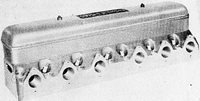
A few years ago I came to realise that the Chrysler Australia Hemi 6 has a uniform port location for each cylinder, quite different to what I've been used to looking at with many other sixes, particularly the Holden.
Standard pattern, in my view, is from the front, exhaust, inlet, inlet, exhaust, exhaust, inlet, inlet, exhaust, exhaust, inlet, inlet, exhaust. Or more easily: E I I E E I I E E I I E. This was the pattern on Holden and Chevrolet.
The Ford Zephyr inline six was the same, as was the Volvo B30, the BMC B-series 6 (Australian production only in Freeways and Wolseley 24/80), the BMC C-series (Healey 3000 etc) and others.
However, having seen the difference in the Hemi 6 I started to look at others. The Slant 6, for instance.
Hemi 6 is E I E I E I E I E I E I, the slant is E I E I E I I E I E I E , a sort of mirror-reverse for each end of the head. The Hemi's pattern is the same as Ford's 250/300, I gather.
I mentioned the B-series sixes, which were two extra cylinders added to the well-known B-series 4-cylinder engines, which was also the case with the Volvo B30/B20 engines. The 'pattern' of the ports on these engines were as if two cylinders were added at one end.
But on the Nissan L-series engines it's the same addition of two cylinders, but in this case as if two cylinders are added in the middle. Their port order then became E I I E I E E I E I I E which looks decidedly odd to those used to more conventional patterns.
The other aspect to this is the effect on camshafts. This comes to mind as it's been pointed out to me that the Hemi 6 cam - like most running in four bearings - has two lobes (No 5 inlet and No 6 exhaust) which are remote from the bearings and open and shut at the same time. Further, it was pointed out to me that this leads to flexing when heavier valve springs are in use and would be the root cause of undue wear in the oil pump drive gear.