O.k. . . .
First of all I want to be clear that I am NOT being argumentitve here but rather I'm still searching for an honest understanding on this issue, that being said . . . consider this:
If you divide by 6 . . .
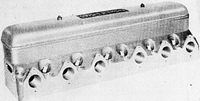
A 261 cu.in. engine is equal to 43.5cu.in. per cylinder. Interestingly enough if you multiply 43.5 by 8 you get 348 cu.in.
So what we have found here is that on a "cylinder to cylinder" basis the "little" 261 is actually just a "350" with two less cylinders.
That is to say, the cylinders on each motor are processing roughly the same amount of air on each stroke. So this means that per "individual combustion unit" the 261 and the 350 are very nearly the same size. . . . Agreed so far ?
The cylinders all operate independently in regard to intake,combustion and exhaust and are tied together only at the crank shaft. These cylinders do not "know" what configuration they are arranged in, Inline ,V , or opposed.
The events that take place during the cycle are the same within each cylinder regadless of number or configuration.
So there-in lies my delemma . . . . . .
I agree that the whole reason for using a modified exhaust (headers) is to facilitate the rapid and smooth evacuation of gasses from the cylinder via the exhaust port and in most cases reduce the excessive back pressure caused by poorly designed exhaust manifolds.
If a V-8 engine benifits from the use of a balance tube or crossover down stream from the headers,it seems to me it does so "one cylinder at a time". So what I'm having trouble seeing is why ANY engine would not see a simillar benefit on a "cylinder by cylinder" basis.
Isn't the goal of any engine design to make each cylinder run as close to the same as each other as possible so they do not "fight" each other and inhibit performance ?
If a balence tubes goal is to help equalize back pressure to all cylinders then will that not increase each cylinders likelyhood of performing more evenly and thus driving the crank with a more simillar force ?
I understand that maybe I am oversimplifying this somewhat but I do not see any issues created by the "inline" configuration alone that would make it "immune" to benefitting from this performance enhancing modification.
I am, however, quite willing to be persuaded to believe differently based on something of a design nature. Something along the lines of port design, un-equal runnerlength or a cooling issue resulting in widely varied cylinder temperatures.
I just can't seem to dismiss it as a "Inline thing" . . . . .
Still wondering . . . . .
'Crockett