|
|
Joined: Apr 2006
Posts: 20
Active BB Member
|
OP

Active BB Member
Joined: Apr 2006
Posts: 20 |
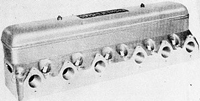
Finally putting my 250 back together bought arp studs for the head when I put the drivers side front sud in it hits the water pump impeller anybody elese run into this problem?? Can I just back the stud out so it does not hit??
|
|
|
|
|
Joined: Oct 2002
Posts: 787
Major Contributor
|
|
Major Contributor
Joined: Oct 2002
Posts: 787 |
I'm sure Twisted has the defintive answer for your problem. As a general note threaded devices are designed to be used at the square of the thread. That is if it is a 3/8-16 it should be threaded at least 3/8 into the material. I was told this by an Engineer many years ago and have always followed it. That's not to say that additional thread wouldn't exceed the strength of the threaded materal.
Larry
Ignorance can be fixed Stupidity is forever
|
|
|
|
|
Joined: Jul 2000
Posts: 4,618 Likes: 24
1000 Post Club
|
|
1000 Post Club
Joined: Jul 2000
Posts: 4,618 Likes: 24 |
Mark the stud anyway that you can so that when you back it out You can Cut it off Then Reinstall it. Also Be sure to use a sealer on the treads.And Now depending on the valve cover you use the Cover may also need a little triming TO clear the Upper part of the stud Or Nut.
Larry/Twisted6 [oooooo]  Adding CFM adds boost  God doesn't like ugly.
|
|
|
|
|
Joined: Apr 2005
Posts: 364
Contributor
|
|
Contributor
Joined: Apr 2005
Posts: 364 |
The "square" rule applies to bolted joints where the strength of the material of the internal threads (a nut or tapped hole) is the same as that of the cap screw or stud. The general rule for a high-strength steel stud threaded into cast iron is for the length of the good tapped threads to be 1.5 times the diameter of the stud or cap screw. Thus, a 0.500" diameter stud should be installed in a tapped hole with 0.750" of good thread.
Hoyt, II#922
Hoyt, Inliner #922
|
|
|
|
|
Joined: Oct 2002
Posts: 787
Major Contributor
|
|
Major Contributor
Joined: Oct 2002
Posts: 787 |
Hoyt, Thanks for the clarification, as I said it's been a few years, and I may of only remembered the part that was relevant at the time. That's interesting, I don't want to get any deeper. I can see that stud has a different function than say a bolt. I'll try and remember that rule too. I'm curious have you reached the maximum strenght at the "square" or 1.5 times or will additional threads add some additional strenght?
Larry
Ignorance can be fixed Stupidity is forever
|
|
|
|
|
Joined: Jul 2000
Posts: 4,618 Likes: 24
1000 Post Club
|
|
1000 Post Club
Joined: Jul 2000
Posts: 4,618 Likes: 24 |
Once a bolt passes past what ever threads It does nothing but hang there. It was always my understanding What ever the DIA. of the bolt is,Is all you need for depth.And if you look at most Blocks there is not much more then 3/4in of threads in the deck.So how would you ever get 1.5 times??
Larry/Twisted6 [oooooo] Adding CFM adds boost God doesn't like ugly.
|
|
|
|
|
Joined: Feb 2003
Posts: 163
Contributor
|
|
Contributor
Joined: Feb 2003
Posts: 163 |
Our local machine shop uses loctite to secure the studs in the block. Working fast they goop up the threads and insert each one in place then install and torque the head down to spec. This pulls the stud up against the block so next time you torque down the head for real, the studs will pull against metal instead of loctite.
|
|
|
|
|
Joined: Apr 2005
Posts: 364
Contributor
|
|
Contributor
Joined: Apr 2005
Posts: 364 |
Larry and Larry,
I recently bought a set of ARP studs for the head and #2 and 3 main caps for my 261, and the ARP technical consultant felt that the 1.5 ratio was good. Thus, for a 1/2" cap screw, there should be 3/4" of tapped threads in the cast iron block. For a 9/16" thread (as for the center mains on a 261) this would about 27/32". All of the tapped holes in the 261 are about one inch, +/- 1/16", so the 1.5 time diameter rule is met. I have never measured the thread depth on the later Chevy sixes. The real requirement is that the threads on either the cap screw or in the block do not fail (that is, strip) before the tensile load in the cap screw or stud reaches its maximum. Note that the nuts for a high strength bolt are less than one diameter in length. For example, the nut height for a 1/2" bolt is 7/16". Since cast iron cannot carry as much stress as high strength steel, more threads are required in the cast iron to carry the load and to prevent stripping the cast iron thread if a lot of torque is applied to the head of the bolt (or nut, if one is using studs).
If somebody had a junk block sitting around, an experiment could be conducted to see just how much thread engagement is required to prevent stripping the cast iron threads for a given amount of torque. Some of the technical references say that only six good threads are required. This would be about 15/32" for a 1/2"-13 cap screw.
Hoyt, II #922
Hoyt, Inliner #922
|
|
|
|
|
Joined: Oct 2002
Posts: 787
Major Contributor
|
|
Major Contributor
Joined: Oct 2002
Posts: 787 |
Hoyt, Thank you much, it isn't quite what I was expecting, but it all makes sense. I guess I wasn't thinking there was that much difference between cast iron and steel threads DUH. The next time I have to come up with a work around I'll be much better prepared. Thanks again.
Larry
Ignorance can be fixed Stupidity is forever
|
|
|
|
0 members (),
615
guests, and
344
robots. |
|
Key:
Admin,
Global Mod,
Mod
|
|
|
|