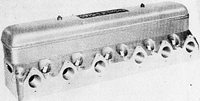
As jimmy six points out, the air/fuel ratio (and hence, the fuel consumption and power) is pretty much set by the jet sizes in the carburetor, and the A/F ratio should be about the same if you have one, three, or five carburetors. However, at low engine speed and part throttle, as encountered while cruising at 30 mph for example, the airflow demanded by the engine to put out only about 10 HP is so low that the air/fuel ratio will probably start to change due to the very low "venturi signal" that is generated in the carburetor. The venturi signal, which is the pressure differential that "sucks' the fuel through the jets, is proportional to the square of the airflow through the venturi. It is possible for the venturi signal to become so low that the head offset between the fuel level and the fuel discharge tube cannot be overcome and the fuel flow goes to zero. Thus, for a given airflow demand, the three-carb engine will see only one-ninth the venturi signal that will be generated by the one-carb engine, and the low speed performance and fuel economy of the three-carb engine will suffer. Conversely, at high airflow demand, the three-carb engine will see only one-ninth of the pressure drop through the carburetors, and should produce significantly more top-end power.
I had not fully comprehended these effects until I talked to Tom Langdon a few months ago and told him that I was planning on using five Strombergs on my 261. I then looked at some textbooks on carburetor performance and realized what happens at very low (but still above idle) airflow through a carburetor. If there is no pressure loss through the air filters and carburetor inlet, the air/fuel ratio leans out significantly. However, is there is much of a pressure drop through the filter, the mixture can become too rich at low airflow demand. I have generated a fairly simple spreadsheet simulation of the air and fuel flow through a carburetor and would be happy to share it with anyone as crazy as I am.
I now have my 261 (278 cubic inches) set up with two Stromberg 97s for primary carbs, with three 48s as secondaries. Both of the 97s will be independently choked.
Back to the original question about whether or not to use a choke on all “active’ carburetors. If one or more of the active carbs are not choked, the manifold pressure will be so high (or the vacuum will be so low) that the choked carburetors will not provide very much additional fuel to richen the mixture when the engine is cold. However, the additional fuel provided by the extra accelerator pumps seems to be effective. Several of the previous posters have also observed these effects. When I had three non-progressive 97s on my 261, I tried just about all possible combinations of choke plate and accelerator pump arrangements. All seemed to work equally well (or poorly when it was –10 degrees F outside). One of the best combinations was all three chokes with the leathers torn off of two of the accelerator pumps.