I've copied the last few entries in the Ball&Ball Woes discussion and started a new one. Flathead inline information is hard to come by and flow of information whether it comes from the briggs 5 hp racer or the Hudson 7x builder is valuable stuff.
The ohv builders take alot for granted that just isn't a possibility with the flatties. On the other hand, flathead inlines possess some traits that that are seldom exploited or refined to compete with the ohv's
Let's hear what you have to say!
The discussion had started as follows:
Jim R
--------------------------------------------------------------------------------
Hudson,
Sounds like you have a heavily modified flathead. Would you care to share some of the details and performance with us?
Jim R
IP: Logged
Hudson
Active Inliner posted 08-21-2001 05:11 PM
--------------------------------------------------------------------------------
First, don't anybody jump out and bore your B&B carbs out to those dimentions. The step up jet is wayyyyy too big. Even though the tractor would run up and down the road like top fuel dragster, its too much fuel under the type of load a tractor pull inflicts on an engine. I buzzed down the track until the load popped up the step up jet - then billowing black soot rolled out, and the rpms stopped going up. I backed out to let the step up seat and hopefully gain my vacuum back, this may work on a drag strip - it won't on a pulling track. The main jet wasn't enough and the step up jet was too much. Ideally, the step up jet would pick up the load and additional fuel needed to sustain the engine. Mine is simply too rich.
Luckily, a new step up jet for these carbs comes with an overhaul kit from The Carburetor Shop in Eldon Missouri.
Now, as for modifications, nothing real outlandish has been done to the engine. It was noticed that is full potential should be gained at 5000 rpm, but the crank didn't seem to want to stand that.
The crank was fully cross drilled from the mains to each adjacent rod and from rod to rod between mains. An oil groove was cut in the main & rod bearings to allow continuous oil flow to the crank at all points. We are running stock stroke and had the entire rotating assembly balanced out to run 6000 rpm.
Another important modification to get this rpm is to plug all the oil bleeds from the rods. Depending on what type of chrysler engine it is, some have holes in the yoke to spray the cam, others have in addition ports drilled through the rod beams to lubricate the wrist pins and spray the piston head. Be sure and plug these up to conserve all the oil and associated cooling in the rod bearing. Almost all the engines we tore down had some degree of damage to #2 and #5 rods, attributed to poor oil distribution and the excessive bleeding of oil from the adjacent rod nearest the source oil port.
The rest is pretty vanilla in terms of hardware. '58 head cut .090, stock valve diameters, homemade split exhaust, and a custom grind on the cam 270 duration seat to seat with a .425 lift and 110 separation angle and centerline.
The valves were left stock because of the shrouding that would occur if they got nearer to the head relief at full lift. We could have ground this shrouding away for better flow, but that costs CC's in a situation that doesn't allow many compression boosts. Perhaps if we stroke it, these CC's can be made up with cylinder displacement. We run 9.5 compression and can burn 93 octane pump gas.
That's about it, nothing very elaborate - but we can turn some wicked sustained rpm's. Two years of some very hard, winding service without a hitch. We needed some more induction, just need to get it harnessed!
Hudson
IP: Logged
frank
Active Inliner posted 08-21-2001 08:24 PM
--------------------------------------------------------------------------------
Hey Hudson, would one cylinder be considered in-line?
I've had a lot of experiance with flathead one cylinder engines. We had a lot of restrictions on our rules so we had to get inovative.
One thing to improve breathing without disturbing the combustion chamber is to move the head off center towards the valves. By either necking down the head bolts or sloting the head bolt holes in the head. The more tne better, but in the Briggs, in order to still have enough gasket surface 0.070 to 0.080 was all we could go and it made a significant improvement.
Another thing we did was to reduce the head diameter on the valves, thus putting the margin near the edge of the valve. This seemed to work well also to increase flow.
These two things helped us get suspended from racing and asked to never return.
Frank
IP: Logged
Hudson
Active Inliner posted 08-21-2001 10:01 PM
--------------------------------------------------------------------------------
I hear you Frank, and the briggs is the defining flathead to me. I don't race them, but one has to admire their tenacity and durability! Not to mention their outright punch for such a little package.
You are exactly right about the valve arrangement and scooting the head over on the briggs. The '58 head already has that licked over the earlier heads for the little chryslers. The valve pockets are just enough around the stock valve diameters to flow good, but close enough for a good compression. Instead of the long air port over the top of the piston, it has a deeper, shorter air pocket that saves compression but flows better. Sometimes bigger isn't always better, especially when you consider the limitations of the simesed intake runners.
Our valves are setup just like yours in the briggs, barely grabbing the edge of a 3 angle job with plenty of meat in the valve head to keep the edge from rolling up. It may not be textbook, it was the machinist's doings - but it worked! (he had built a briggs or two himself)
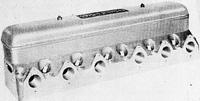
To diverge from the mopar a little, my preoccupation with Hudson flatheads stems from the fact that their valves are canted towards the cylinder at an angle, they have 12 large ports, and you can run a higher compression with the ability to breathe better than the "big three" flatties.
To put that in Briggs perspective, wouldn't you love to regrind and reseat your valves right up to the edge of the cylinder at an angle and fill up all that backspace? Ohhhh Boy!
Keep them Briggs a rollin!
Hudson