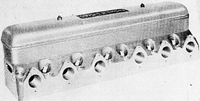
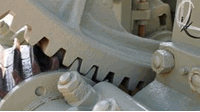
Hud I is my Dad, the engine he's talking about is the same engine that was in "Let's talk". We ran across all kinds of rods. Some had the holes in the side, others had holes through the beams to the wrist pins in addition to the yoke holes. The ones that went in the engine are like Pop said, the oil holes in the yoke that sprayed the cylinder were left open.
Alot of water has gone under the bridge since then. At the time of the intial thread, I advocated plugging them up and conserving as much oil as you could in the rod. We were worried about oil loss then, noting previous failures in the rod journals when spun up to high rpms. Pop's cross drilling did away with that and oil delivery is not a problem.
If you are going to drive the flathead alot, I'd say the cylinder oiling aspect is a good thing. The rod sprays oil on the trust side of the cylinder. That is a very effective cooling mechanism as far as the piston/cylinder goes and sure doesn't hurt your lubrication on important surfaces.
The heat problem we've noticed is the external surfaces of the engine. Both the little mopar and the Hudson. Water temps are fine, the engine seems just as happy as can be, but they get really hot on the external surfaces. I don't really know how to explain it. I think its a combination of the thickness of the castings (more heat retention due to its mass) and the thermal conductivity of the metal. The flathead may actually be doing a better job of getting heat away from the internals and sending it out where it can be exchanged with the ambient air. The lower water temps would indicate that.
For example. The flathead tractor can make a run - and you can't lay your hand on the oil pan. The 292 tractor can make a run, and the oil pan is only warm. The flathead weighs twice what the 292 does. Same thing applies to the side of the block, the head, etc. However, the 292's water temperature will be higher.
I don't think its a big problem, because nothing seems to be hurting over it. Its just odd.
Hudson