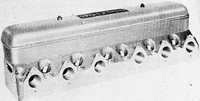
Stroke length was not (as much) penalized by older registration and tax rates (as Ray just said), but it's also the most practical way to get a long L6 engine into a small to mid-size car, which was a big sales point for Chevy and Ply-Do.
If you reduce the bore pitch and piston size to shrink the overall length and weight, stroke is what's left to make the engine big enough.
In a flathead, it also helps keep the chamber area (not necessarily volume) under control, and (by reducing the bore size to keep the same displacement) shorten the quench distance, which is typically from the plug to the opposite side of the chamber.