|
|
|
|
Joined: Apr 2012
Posts: 17
Active BB Member
|
OP

Active BB Member
Joined: Apr 2012
Posts: 17 |
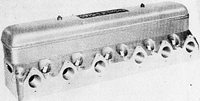
1966 194. had to have the seals renewed on my head. I got it back from the machine shop, with the two studs removed. Nothing looks damaged. a 3/8-16 hardware bolt goes into both stud locations in the head just fine. the studs which are 3/8-16 by 3/8-24 (I think) will not easley thread into the head, or a 3/8-16 hardware nut. It feels like damaged threads at the tip of the course side of the stud, or a crossthread, but its straight on going in.
has the 3/8-16 side of these studs been factory machined in a way so they don't back out easley. I find it unlikely they are both damaged as either stud is the same in either hole or a hardware nut, and either bolt hole readily accepts a 3/8-16 hardware bolt.
Am I correct or has coincidence beat the odds? Thanks
Last edited by true blue 6; 03/20/15 07:27 PM. Reason: proof read
|
|
|
|
|
Joined: Sep 2004
Posts: 5,840 Likes: 1
1000 Post Club
|
|
1000 Post Club
Joined: Sep 2004
Posts: 5,840 Likes: 1 |
Maybe someone put metric studs in it?
MBHD
12 port SDS EFI 
|
|
|
|
|
Joined: Apr 2003
Posts: 1,563 Likes: 18
1000 Post Club
|
|
1000 Post Club
Joined: Apr 2003
Posts: 1,563 Likes: 18 |
Nothing looks damaged. a 3/8-16 hardware bolt goes into both stud locations in the head just fine. the studs which are 3/8-16 by 3/8-24 (I think) will not easley thread into the head, or a 3/8-16 hardware nut. So a 3/8 coarse bolt goes in smoothly - but the coarse side of the studs you have will not? Nor will the coarse side of the studs accept a 3/8 coarse nut? I would be scrutinizing the studs not the head. I would chase the threads in the head with a 3/18 16 tap and shop for some new studs.
|
|
|
|
|
Joined: Apr 2012
Posts: 17
Active BB Member
|
|
OP
Active BB Member
Joined: Apr 2012
Posts: 17 |
Thank you for the replies, I did fail to mention that the studs are original. I did also since the first post, try to thread the nuts on to the clamp side of the studs. Each of the studs 3/8-24 threads are doing the same thing as the course side, and I know it was not doing this, because I was the one to remove the nuts.
Not sure what happened when these studs were removed at the machine shop, the machine shop did not teeth them up wih a set of vise grips. Unless they were mixed up with a Chrysler job in the shop at the same time, these appear correct and have traces of orange, so I assume there mine.
Just wanted to call out to this site before I take a die and destroy an intended inference that has a purpose, perhaps like a rocker arm nut. Probably a little overboard try to save the original studs, its just that they are the original studs. Thanks everyone.
|
|
|
|
|
Joined: Jun 2000
Posts: 272
Contributor
|
|
Contributor
Joined: Jun 2000
Posts: 272 |
Buy new studs. They are cheap insurance.
|
|
|
|
|
Joined: Jan 2015
Posts: 376
Contributor
|
|
Contributor
Joined: Jan 2015
Posts: 376 |
I got new studs and I threaded them in after washing the head threads out thoroughly with brake cleaner. Any little particles of dirt in there will cause the studs to not thread in easily. I have that same problem on my new 292. A few do and a few don't and its because there is particles in the threads....and some paint. lol But vice grips take care of the problem. 
|
|
|
|
|
Joined: Apr 2003
Posts: 1,563 Likes: 18
1000 Post Club
|
|
1000 Post Club
Joined: Apr 2003
Posts: 1,563 Likes: 18 |
Just wanted to call out to this site before I take a die and destroy an intended inference that has a purpose, perhaps like a rocker arm nut.
Even with an interference fit - they should still start cleanly. As I understand it interference fasteners are first threaded oversize for entire thread length - and then threaded true for perhaps a quarter of the threads. This allows them to start and then get tighter and tighter as more of the over-size threads are engaged.
|
|
|
|
|
Joined: May 2009
Posts: 493
Contributor
|
|
Contributor
Joined: May 2009
Posts: 493 |
I've seen exhaust manifold bolts for big block Chevy that have a large root diameter on the threads, apparently to provide interference fit between minor diameters. Seen it more than once, so I think it was intentional. Anyone else seen this?
Not a six, sorry...
|
|
|
|
|
|
|