|
|
Joined: Apr 2004
Posts: 3,556 Likes: 35
1000 Post Club
|

1000 Post Club
Joined: Apr 2004
Posts: 3,556 Likes: 35 |
doug, it is definately a aftermarket part. the cast is of a finer design and good quality. i will check and see if they designed it for use with a divided head. tom
Inliner Member 1716 65 Chevelle Wagon and 41 Hudson Pickup Information and parts www.12bolt.com
|
|
|
|
|
Joined: Dec 2008
Posts: 84
Active BB Member
|
|
OP
Active BB Member
Joined: Dec 2008
Posts: 84 |
Thanks.
Even if a complete head is not available, some company there may have commercialized an add-in kit to split the intake; otherwise it wouldn't seem reasonable to sell the split manifold.
|
|
|
|
|
Joined: Sep 2004
Posts: 5,839 Likes: 1
1000 Post Club
|
|
1000 Post Club
Joined: Sep 2004
Posts: 5,839 Likes: 1 |
If you guys can buy a 12 port head from Brazil,SPA sells a turbo exhaust manifold for that cylinder head also,,,,from what I have been told.
The 12 port intake will work with a throttle body & F.I.,but I have been also told it is restrictive.
MBHD
12 port SDS EFI 
|
|
|
|
|
Joined: Apr 2004
Posts: 3,556 Likes: 35
1000 Post Club
|
|
1000 Post Club
Joined: Apr 2004
Posts: 3,556 Likes: 35 |
if that is the case, i am a dealer for spa and can get it. i'll check and see if they can also supply used heads. it would be helpful to get the motor model and years of production. tom
Inliner Member 1716 65 Chevelle Wagon and 41 Hudson Pickup Information and parts www.12bolt.com
|
|
|
|
|
Joined: Dec 2008
Posts: 1
Newcomer
|
|
Newcomer
Joined: Dec 2008
Posts: 1 |
Hi
I have also wondering this situation of siamesed ports and try to find more information of inliners one heads and tried to find also about v8 head to inliners.
But if somebody find used heads I would be intrested.
|
|
|
|
|
Joined: Aug 2006
Posts: 232
Contributor
|
|
Contributor
Joined: Aug 2006
Posts: 232 |
Brazilian GM 250 Engine, 4.1L, 12 Port Head 1995 to 1998 Silverado, 138 Hp, V8 bell housing pattern 1995 to 1998 Omega, 168 Hp, Opel 3.0L bell housing pattern 12 port engine, 6" rods, lighter piston with shorter compression height Multi-port fuel injection, one piece rear main seal, cast dual exhaust manifold Cylinder Head GM Part Numbers 93216528 Cylinder Head 93.238.389 Cylinder Head Complete 93.205.909 Cylinder Head Bare Pistons, GM Part Numbers ('95 - '98) 93225129 Piston, 0.030 overbore 93225130 Piston, 0.040 overbore Connecting Rods, 6", GM Part Numbers ('95 - '98) 93205918 Connecting Rod, 6" The above is information I have collected over a period, some from this forum. Please confirm before ordering. The Brazilian parts are expensive, for whatever reason. The general tariff is supposedly approximately 30%. The Brazilian engine parts are 3 to 5 times more expensive than similar US engine parts. A pipeline to get Brazilian parts at reasonable price is an idea. I'm personally interested in a real flat top cast piston, preferably hypereutectic. I searched the web and called Federal Mogul and others with no luck yet. The 307 "flat top piston", Federal Mogul 295AP, has very large chamfer around the top edge. This negates some of the effects of a proper quench. I assume this large chamfer was one measure to help reduce unburned hydrocarbons before the use of catalytic converters. The 1968 and 1969 Pontiac OHC 6 250 had a real flat top piston, GM P/N 9784340,(a standard bore set is currently on sale on e:bay). The piston had deep valve reliefs, for a non-interfernce engine, incase the OHC belt failed. This piston is no longer available. A 3 7/8" version of the 4" Federal Mogul H660P piston, flat top hypereutectic, for the Chevrolet 327 would be great (5.7" rod). Path to photos of Brazilian Chevrolet 250 Cylinder Head: http://www.goravenswood.com/links.htm / Engine / Entre / Cabecotes Pontiac OHC 6 250 Flat top piston e:bay Item Number 120320658687
|
|
|
|
|
Joined: Sep 2008
Posts: 3,669 Likes: 42
1000 Post Club
|
|
1000 Post Club
Joined: Sep 2008
Posts: 3,669 Likes: 42 |
Good info! Just for curiousity's sake, have you ever gotten any price quotes for a Brazilian 12 port head, either bare or complete! Thanks....
Class III CNC Machinist/Programmer
|
|
|
|
|
Joined: Dec 2008
Posts: 84
Active BB Member
|
|
OP
Active BB Member
Joined: Dec 2008
Posts: 84 |
In the photos on the Ravenswood site, the differences between the 9 port and the 12 port are certainly obvious and interesting. I assume that the 12 port is compatible with the earlier 194/250/292 blocks? I tried the GM parts listings to no avail, so this is apparently not available domestically. One would think that GM would offer it in the performance catalog...
|
|
|
|
|
Joined: Aug 2006
Posts: 232
Contributor
|
|
Contributor
Joined: Aug 2006
Posts: 232 |
CNC-Dude, sorry, no prices for the Brazilian cylinder head.
DougE, neither GM or Federal Mogul in the USA will help concerning the Brazilian engine parts, neither technical information or part numbers. I contacted both companies in the USA.
|
|
|
|
|
Joined: Dec 2005
Posts: 452
Contributor
|
|
Contributor
Joined: Dec 2005
Posts: 452 |
GM of Brazil no longer makes or stocks the 12 port head you have to find one at a dealer to get one, this is what I was told.
I paid about $800.00 for a new bare head as I remember. A new USA siamesed head costs about $500.00 now. Will post the casting number of the Brazil 12 port head.
Harry
Turbo-6
|
|
|
|
|
Joined: Dec 2005
Posts: 452
Contributor
|
|
Contributor
Joined: Dec 2005
Posts: 452 |
Found the info. on the Brazil 12 port head:
Casting number- 93 216 528
PN - 93 205 909 bare/machined
PN - 93 238 389 complete about
Harry
Turbo-6
|
|
|
|
|
Joined: Sep 2008
Posts: 3,669 Likes: 42
1000 Post Club
|
|
1000 Post Club
Joined: Sep 2008
Posts: 3,669 Likes: 42 |
[quote=DougE]I've done many "lump" siamese heads that had the intake ports flow over 330 CFM OK, Larry,,,,,Twisted6,,,,what are we not doing????? Besides breaking into water jackets & a lot of welding & epoxies? MBHD What kind of #'s are you seeing with what you are doing?
Class III CNC Machinist/Programmer
|
|
|
|
|
Joined: Sep 2004
Posts: 5,839 Likes: 1
1000 Post Club
|
|
1000 Post Club
Joined: Sep 2004
Posts: 5,839 Likes: 1 |
This fool is still ranting,he says his flows 240 CFM @ .500 I will deleat my previous statement here on this post as he has cleaned up his auction BS. It appears to have a broken stud & or studs,& there is no stament in the auction about that. http://cgi.ebay.com/ebaymotors/Chevy-Inl...sQ5fAccessoriesLooks like he took off all the BS from his auction. So it seems he is still lurking :-) That flow number of 240 is about correct for a nicely done cylinder head it seems,still don't know how you get 330 CFM. Mike Kirby has a Hendric (SP) cylinder head @ his shop that flows 330 CFM,,,but they ported into water jackets,rebrazed or epoxied all back up. It has the bowls really widened up,but into water jackets.
12 port SDS EFI
|
|
|
|
|
Joined: Sep 2008
Posts: 3,669 Likes: 42
1000 Post Club
|
|
1000 Post Club
Joined: Sep 2008
Posts: 3,669 Likes: 42 |
Well, at the 330 cfm level, it definately isn't a street head! It is very thin all over. "Huge" intake valves, very tiny combustion chambers, this also unshrouds the intake valves unbelievably well because the chamber is so shallow,you will see a big jump in flow by doing this. But compression will sky rocket. Also, keep in mind, to achieve this level of flow and HP, you need to make the bowl area at least 85% of the size of the valve you are using, and this should be machined and not ground with a grinder. Also,a 2.02 valve will still be too small to see those kind of #'s. And finally, if you do all the above mods, this last step is the most critical and very important, and if you don't do it,not only will you loose valuable flow and HP, but potential engine damage can occur. Because you have now made the head so thin and flimsy, by decking it so much and removing so much material from the ports, and removing the head bolt bosses, and heating to apply brazing material, you absolutely have to do the valve job with a torque plate bolted to the head. It distorts so much when you torque the head to the block if you dont, that the valves wont seat. Even pulling the head between rounds at Indy and other races, I had to put the torque plate on it just to lap the valves, its that critical. Much of the epoxy and chamber brazing you saw with the head Kirby has is most likely a repair. We were constantly having to replace the entire combustion chambers on several ports, because the head was milled so much and the deck was so thin, the compression so high, the chamber would seperate from the head entirely. I've often wondered what the practical limit would be for those heads as far as flow goes for the street, having a good reliable good flowing head and not having a time bomb. 280...300 CFM, I've been thinking about doing another one on the conservative side, just to see, since there seems to be a lot of interest in these engines growing.
Class III CNC Machinist/Programmer
|
|
|
|
|
Joined: Jan 2005
Posts: 3
Newcomer
|
|
Newcomer
Joined: Jan 2005
Posts: 3 |
Think about this in relation to siamese intake ports. As no. 1 piston is on the intake stroke the cylinder is filling with the intake charge. Due to the crankshaft design of 120 degrees between throws the ajoining cyl, no.2 intake vale breaks off its seat and the no.1 cyl stops filling. The cure, have the crank throws come up together and change the firing order, buy a 12 port head, or divide the intake port. Each has its drawback. I had this discussion with nonother than Bruce Crower many years ago. Ed Farrell
|
|
|
|
|
Joined: Sep 2008
Posts: 3,669 Likes: 42
1000 Post Club
|
|
1000 Post Club
Joined: Sep 2008
Posts: 3,669 Likes: 42 |
Well, the siamese port cofiguration has never really been an issue until more recently, when fuel injection has been adapted to these engines, and the intake valve overlap of adjoining cylinders begins to play its part. Many very high HP engines have been built using these heads for over 30 years and have been very effecient with carburetors and reliably as well. Its just trying to figure out how to make one injector feed 2 cylinder that share the same intake port that has shown a need to try and develop other solutions, that were never really a problem otherwise.... It would be very easy to swap #2 with #5 cylinder on the cam,as a possible solution, since they are at the same position on the crankshaft at the same time for a timing swap. That might be something to consider for the fuel injection guys that still want to use the siamese head possibly. tlowe has encountered leaning conditions in his engine with fuel injection, and has found that dividing the intake port has shown to be a considerable improvement and possible remedy for this problem altogether. And quite possibly, the simplest cure for siamese port issues.
Class III CNC Machinist/Programmer
|
|
|
|
|
Joined: Jan 2005
Posts: 2,123 Likes: 3
1000 Post Club
|
|
1000 Post Club
Joined: Jan 2005
Posts: 2,123 Likes: 3 |
As no. 1 piston is on the intake stroke the cylinder is filling with the intake charge. Due to the crankshaft design of 120 degrees between throws the ajoining cyl, no.2 intake vale breaks off its seat and the no.1 cyl stops filling.
The adjacent pairs are as separated as they can be.
The center #3-4 pair have symmetrical 360° - 360° - 360° interval of separation.
The #1-2 and #5-6 pairs have an irregular interval: 240° - 480° - 240°, etc.
If the intake duration exceeds 240°, the later cylinder will cause a minor leak as its valve begins to open, but since this is BTDC vacuum is minimal, and no actual flow will occur until the piston moves down ATDC a bit and the lift reach perhaps .020". The earlier cylinder is already coming up to compression in any case.
In addition, #1 & 6 do not have this problem, since their complementary cylinders (#2 & 5) are 480° later and cannot interfere.
Swapping the lobes to substitute 2 for 5 will subject the crank to higher torsional loads. Development of L6 engine blocks and cranks dates to before WW1; everything you can think of has been tried, patented, and in most cases failed. I can't find an L6 with a firing order that places 3 power strokes at one end of the crank, then 3 at the other.
Dividing the ports will certainly cure the EFI distribution problem, but will reduce peak power as all the racing head prep has show. There's just not enough port area.
|
|
|
|
|
Joined: Dec 2005
Posts: 452
Contributor
|
|
Contributor
Joined: Dec 2005
Posts: 452 |
Distribution in a siamesed port is not just a problem with EFI actually it's less of a problem than with carbs, since you can put the fuel right into the port.
Turbo-6
|
|
|
|
|
Joined: Sep 2008
Posts: 3,669 Likes: 42
1000 Post Club
|
|
1000 Post Club
Joined: Sep 2008
Posts: 3,669 Likes: 42 |
I personally have never had problems with the fuel distribution or reversion issue that many people say plague engines with siamese ports. I assumed their circumstances were unique to what they were or weren't doing compared to what I was experiencing with many of the Comp Eliminator engines i've had my experience with. panic mentioned some guidelines he felt should be observed to help aleviate this "phenomenum", if you want to call it that, in regards to camshaft duration. But i've used camshafts in 292's that have had well over 320 degrees duration @.050, and over .900 lift at the valve, and not had issues that you could say were from reversion or fuel distribution because of having siamese ports. So I, really don't know what problems people are actually having, except what tlowe has shared with us in his port dividers he has made....
Class III CNC Machinist/Programmer
|
|
|
|
|
Joined: Jan 2005
Posts: 2,123 Likes: 3
1000 Post Club
|
|
1000 Post Club
Joined: Jan 2005
Posts: 2,123 Likes: 3 |
you can put the fuel right into the port
But that's not the problem.
|
|
|
|
|
Joined: Jan 2005
Posts: 2,123 Likes: 3
1000 Post Club
|
|
1000 Post Club
Joined: Jan 2005
Posts: 2,123 Likes: 3 |
mentioned some guidelines he felt should be observed
Sorry - what were those again?
|
|
|
|
|
Joined: Sep 2008
Posts: 3,669 Likes: 42
1000 Post Club
|
|
1000 Post Club
Joined: Sep 2008
Posts: 3,669 Likes: 42 |
mentioned some guidelines he felt should be observed
Sorry - what were those again?
If the intake duration exceeds 240°, the later cylinder will cause a minor leak as its valve begins to open, but since this is BTDC vacuum is minimal, and no actual flow will occur until the piston moves down ATDC a bit and the lift reach perhaps .020". The earlier cylinder is already coming up to compression in any case. In addition, #1 & 6 do not have this problem, since their complementary cylinders (#2 & 5) are 480° later and cannot interfere. I believe this is what I was thinking about that you mentioned.
Class III CNC Machinist/Programmer
|
|
|
|
|
Joined: Dec 2005
Posts: 452
Contributor
|
|
Contributor
Joined: Dec 2005
Posts: 452 |
I'm not referring to driveability problems as tom is, but when you need to put in enough fuel to support over 600 HP you start to see the distribution problems in the siamesed ports, especially with carbs.
So if it effects the fuel at high HP it must have some effect on fuel anytime. A divided port on the street would still support over 250 HP (naturally aspirated) and have all the benefits of a small port. If this is not true the V8 guys should cut out their dividers and small blocks will out flow the big blocks.
Turbo-6
|
|
|
|
|
Joined: Sep 2008
Posts: 3,669 Likes: 42
1000 Post Club
|
|
1000 Post Club
Joined: Sep 2008
Posts: 3,669 Likes: 42 |
The 600HP level is well within the range im seeing with the 292's in Comp. We've always used a plenum style sheetmetal intake with(3)500 Holley 2bbls.,(1)carb inline with each intake port.
Class III CNC Machinist/Programmer
|
|
|
|
|
Joined: Dec 2005
Posts: 452
Contributor
|
|
Contributor
Joined: Dec 2005
Posts: 452 |
Yes, but over 600HP you will have problems on siamesed ports that is one reason everyone went to Ford 300's then AJ's aluminum head then 4200's all with divided ports, Nobody runs 250-292 style siamesed ports now.
Turbo-6
|
|
|
|
|
Joined: Jan 2005
Posts: 2,123 Likes: 3
1000 Post Club
|
|
1000 Post Club
Joined: Jan 2005
Posts: 2,123 Likes: 3 |
panic mentioned some guidelines he felt should be observed to help aleviate this "phenomenum", if you want to call it that, in regards to camshaft duration.
Not a guideline at all, obviously no serious engine has a nominal intake duration below 240°.
It's a comment about something that happens, but evidently the results are small enough not to be detectable as a problem.
Vizard wrestled with a problem of similar nature but greater magnitude on the Mini (with different duration and firing order numbers, of course - the point of event overlap is only 180°, so the duration where both valves of a shared port are open is far longer with a given intake cam) to get past an effective ceiling beyond which more intake event wasn't producing the expected results.
His cure was fairly minor changes in the LSA and intake/exhaust bias between cylinders, depending on their position as early or late in the port's function.
|
|
|
|
|
Joined: Dec 2005
Posts: 452
Contributor
|
|
Contributor
Joined: Dec 2005
Posts: 452 |
Question: What is the highest HP a siamesed port (naturally aspirated) engine has made and can be proven, ie. in a written publication etc.?
My vote is:
Jim Hedrick and Cotton Perry, H/MP Chevy II.
549 HP 1979 Popular Hot Rodding Mag.
Food for thought !
Last edited by Turbo-6; 03/14/09 05:34 PM. Reason: spelling
Turbo-6
|
|
|
|
|
Joined: Sep 2004
Posts: 5,839 Likes: 1
1000 Post Club
|
|
1000 Post Club
Joined: Sep 2004
Posts: 5,839 Likes: 1 |
How about Glen Self,any published HP level or track times ?
MBHD
12 port SDS EFI
|
|
|
|
|
Joined: Dec 2005
Posts: 452
Contributor
|
|
Contributor
Joined: Dec 2005
Posts: 452 |
Yes Glen Self held the national record for his class F/EA, but just recently lost the record to Glen Tredwell now it's 7.95 @ 164.83.
I'm not taking anything away from anyone, all the NHRA record holders make unbelievable HP with what they are working with. If you figure the National Records, ET and Speed, for their legal weights none are making more than mid to high 500's by using their ET's and mid to high 400's by the speed numbers, even with todays new style motors. It's common knowledge that the speed number is a better barometer of the HP of an engine.
I'm just trying to show that no siamesed port motor ever made over 600 HP and trying to approach it had the possibility of being a problem.
Turbo-6
|
|
|
|
|
Joined: Sep 2008
Posts: 3,669 Likes: 42
1000 Post Club
|
|
1000 Post Club
Joined: Sep 2008
Posts: 3,669 Likes: 42 |
Well I worked for Jim for 15 years, and Cotton's engine is the one I was referring to that made over 600 HP. It actually made 612 HP the last time it was dynoed just prior to Indy in 1986, when Cotton drove the F/Dragster of Brian Browell. Cotton actually set both ends of the record for that class at that time. Also, many publications are full of misinformation, either mistaken or intentional, so don't ever believe everything you read in them. But, I can assure you, that there have been quite a few since then that have also seen HP levels above 600 as well. The only thing that was changed on the engine the way it was run in Cotton's Chevy II, before it was put into Browell's dragster was the headers and the oil pan, nothing else....I've also seen the references that were used in Leo's book that were quotes where he was asking Jim about certain subjects like camshaft info and head flow. And what Jim told Leo, was very conservative, in reality to what was actually being done at that time. Jim was extremely secretive about any pertinent info regarding his techniques or knowledge about his engines, and would have never divulged any kind of info that wasn't already public knowledge. Not that Jim intentionally mislead Leo, he just told him things that were done 10 years earlier, and not current methods or concepts for that time period....
Class III CNC Machinist/Programmer
|
|
|
|
|
Joined: Dec 2005
Posts: 452
Contributor
|
|
Contributor
Joined: Dec 2005
Posts: 452 |
I know what you mean about publications with misinformation also now the internet is the same, you have to prove everything to yourself. That's why I always go by the numbers, what was the record of F/D in 1896 and what was the weight to cubic inch factor. E/D is now the old F/D, and the record now for E/D is 7.44 @ 176.81 at 4.50 lbs per cu in that makes about 450 to 500 hp for that ET and speed.
Jim Hedrick has always been my six cly God. He took the Sissel-Kirby bump port head (an ingenious design) and took it to the next level. We are all at a loss without him.
Back in the mid to late seventies, I was just a kid and couldn't hang with my brothers older gang as much as I would have liked. One of his friends built the chassis on the ChevyII and another designed the 3 Holley intake manifold and my brother help build the manifold. Jim and Cotton used our trailer to campaign the Chevy II. Anyway Jim told my brother about changing the cam timming for better mixture control. Do you remember anything on this?
Turbo-6
|
|
|
|
|
Joined: Sep 2008
Posts: 3,669 Likes: 42
1000 Post Club
|
|
1000 Post Club
Joined: Sep 2008
Posts: 3,669 Likes: 42 |
No, I don't recall the actual weight/cid factor for that class that long ago. But the ET was 8.04 and I cant recall the MPH. Cotton and I are actually working on a book similar to Leo's, but it will chronicle his and Jim's accomplishments and contributions to advancing the 6 cylinder. I agree with your earlier comments about the ceiling on the siamese head being in that HP level as a cap. But considering what has been able to be obtained with these heads, despite their shortcomings is pretty amazing to say the least. We had one of Sissell's 12 port aluminum heads to go to the next level with, but NHRA never would make a decision to allow it to be used. The Fords were granted the Billet head to be legal, therefore taking the lead in the inline battle,with a much better cylinder head,unfortunately. Im also doing some "lump" heads for some guys in Brazil, as these engines are experiencing a boom in popularity there, and giving me an opportunity to sort of carry on with the Perry & Headrick legacy in a small way.
Class III CNC Machinist/Programmer
|
|
|
|
|
Joined: Dec 2005
Posts: 452
Contributor
|
|
Contributor
Joined: Dec 2005
Posts: 452 |
Amazing is an understatment, Good luck in your endeavors,keep us posted.
Have you ever done any R&D with a bump port and a divider, bringing the bump out into the manifold. The area at the head surface is similar to the pushrod area on a small block if you make the manifold similar to a chevy port it make work.
Just dreaming!
Last edited by Turbo-6; 03/15/09 03:48 PM.
Turbo-6
|
|
|
|
|
Joined: Jan 2006
Posts: 77
Active BB Member
|
|
Active BB Member
Joined: Jan 2006
Posts: 77 |
I don't know NHRA rules for today, but when I was active in the '60s, weight breaks did not include the driver. In a small digger or altered, the driver can contribute an extra 10% in weight, which throws off computation of horsepower by just using the class weight break for the computation. Another aspect in calculating power is that not all cars can make the min. weight break, but fall into the class anyway.
In 1965, my Chevelle 300DX 2dr sedan with a 350hp 327 fell into the bottom of the A Stock class. A/Stock was the home of the Mopar 426, 427 Fords including the '66 Fairlane, and 427 Chevy Biscaynes. I was not allowed to add ballast to make B/Stock so I taught my wife to run it. The 70 lbs difference made for nearly a tenth, and many sorry looking faces after getting beat by a "girl". Anyway, if one is to calculate power from performance #s, you need to know the actual weight of the car and driver.
|
|
|
|
|
Joined: Dec 2005
Posts: 452
Contributor
|
|
Contributor
Joined: Dec 2005
Posts: 452 |
Today driver weight is included in total weight of car, don't think anyone in Comp will give up anything not to have an edge.
But went back and added 200 lbs to total weights and recalculated HP
ET--650 HP
MPH--525 HP
I have rule books from the 60's will look it up, just to know.
Last edited by Turbo-6; 03/15/09 08:53 PM.
Turbo-6
|
|
|
|
|
Joined: Jan 2005
Posts: 2,123 Likes: 3
1000 Post Club
|
|
1000 Post Club
Joined: Jan 2005
Posts: 2,123 Likes: 3 |
Half of "the Danica Patrick story"...
I agree, the speed number is a better barometer of the HP because it removes the chassis and most of the gearing effect from the equation.
Re: "Not that Jim intentionally mislead Leo"
There's a line in a movie where someone is bragging about what a good pool player he is. He points to the acknowledged old master, and says "he taught me everything I know".
The master pauses and says "but... I didn't teach you everything I know".
|
|
|
|
|
Joined: May 2000
Posts: 1,464
1000 Post Club
|
|
1000 Post Club
Joined: May 2000
Posts: 1,464 |
Today driver weight is included in total weight of car, don't think anyone in Comp will give up anything not to have an edge.
But went back and added 200 lbs to total weights and recalculated HP
ET--650 HP
MPH--525 HP
I have rule books from the 60's will look it up, just to know. I think your calculations are pretty close. The hybrid headed E/D and J/AA Fords are getting over 650 on the dyno, and subtracting about 10% for drivetrain losses puts you back around 600 to the ground. I think e.t. is a better predictor of power-to-the-ground than mph as converter slip or clutch slip can adversely affect mph by a few mph. By the way the Ford hybrid head was made legal when FoMoCo cooperated with some of their racers and assigned a Ford part number to the head and put it in their Performance Parts Catalog for sale. 6RE6
FORD 300 inline six - THE BEST KEPT SECRET IN DRAG RACING!
|
|
|
|
|
Joined: Aug 2011
Posts: 11
Active BB Member
|
|
Active BB Member
Joined: Aug 2011
Posts: 11 |
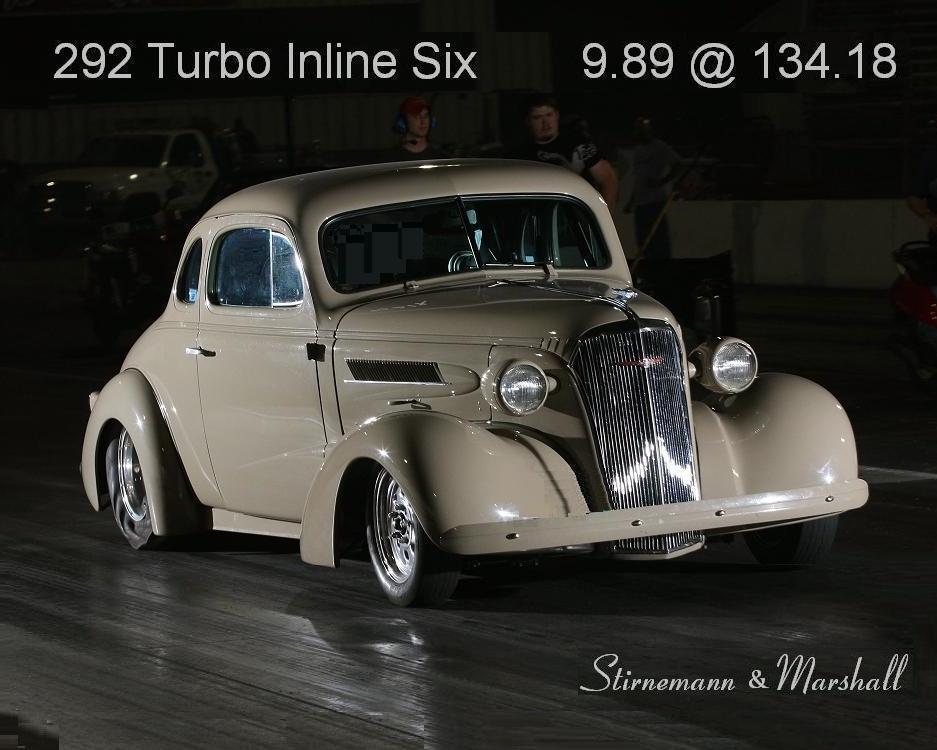
I'm building one, with custom intake and exhaust running a 500 CFM holley, flat top ross pistons, eagle rods, a crane 272 cam, and roller rockers
|
|
|
|
1 members (CrabFoam),
247
guests, and
40
robots. |
|
Key:
Admin,
Global Mod,
Mod
|
|
|
|